

My Revolutionary Huguenot: SAMUEL BACOT, JR.
by Helen DeWitt Whittaker
Member, The Huguenot Society of South Carolina and descendant of the patriot

Revolutionary War hero Samuel Bacot, Jr. was remembered by his contemporaries as “a man of energy, a useful citizen, and an ardent patriot.” His life reflected that reputation in both word and deed.
Samuel Bacot, Jr., the great-grandson of French Protestant (Huguenot) immigrant Pierre Bacot, was born on March 3, 1745, near Goose Creek in Christ Church Parish, South Carolina. On July 13, 1769, he married Sarah Margaret Allston, and the couple settled along the Wateree River near Camden in St. Mark’s Parish. There, Samuel became a successful farmer and plantation owner, devoting himself to managing his lands and raising his children. Until the outbreak of the American Revolution, his life centered on family and agriculture.
When war came, Samuel joined his fellow patriots in service with the South Carolina State Militia. On one occasion, while at home, he spotted approaching Tory forces. Grabbing his musket, he attempted to flee but was briefly delayed by a frightened child. He managed to reach thick cover behind the house just in time. As the soldiers entered through the back door, a sudden musket shot rang out, the ball ricocheting off the walls and door frames. Startled and terrified, the soldiers fled so hastily that they abandoned their horses. Samuel’s family watched their retreat with both relief and amusement. Local rumor later suggested that Samuel’s wife, known for firing a musket to scare off British soldiers and Tories when left alone with the children, may have been responsible for the shot.
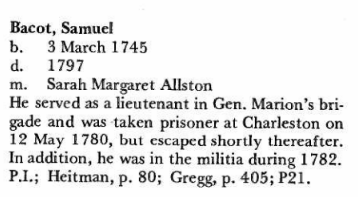
Roster of South Carolina Patriots in the American Revolution, by Bobby Gilmer Moss
Samuel avoided capture until May 12, 1780, when he and approximately thirty others—deemed dangerous to the Crown—were taken prisoner and confined in Camden. British authorities planned to transport them to a prison ship in the Charles-town harbor.
Samuel knew many of the captives personally and identified several he trusted to assist in an escape. He quietly advised them to be alert for any favorable opportunity during the journey. That opportunity came when the guards halted at a deserted log house for the night. The guards slept in the front room near the porch, with their weapons stacked close by, while the prisoners were confined to a separate room with a window.
The agreed-upon signal for escape was the phrase “Saturday night.” The plan was simple but bold: overwhelm the guards, seize their weapons, and vanish into the darkness.
Near midnight, Samuel knocked on the door separating the prisoners from the guards and asked the captain for a drink of brandy. The captain obligingly brought him a glass. Raising it, Samuel declared, “Here is success to Saturday night,” and threw the brandy into the captain’s face. Instantly, the conspirators rushed forward, seized the stacked firearms, and subdued the sentinel. Prisoners who were unaware of the plan either followed the group out the door or escaped through the window. The guards, now outnumbered, surrendered. The prisoners were soon released to return home, and the guards were freed once all captives had departed.
Samuel continued his patriotic service and, in 1782, became a lieutenant under General Francis Marion, the famed “Swamp Fox.”
Around 1778, Samuel and his family relocated to the Black Creek area, later part of Darlington County. He and Sarah Margaret Allston Bacot raised their children there: Peter Hannibal, Maria Allston, Cyrus, Samuel III, Rebecca Foissin, and Laban. Samuel remained deeply connected to his Huguenot heritage, descending from Pierre Bacot (1638–1702) and Jacquine Mercier (1649–1709) of Tours, France.
In recognition of his service and legacy, members of the Samuel Bacot Chapter of the National Daughters of the American Revolution and the Darlington County Historical Society dedicated a historical marker on McIver Road in Darlington, South Carolina, in 1973. The Bacot family cemetery lies approximately half a mile northeast of the marker, behind a field on private property—quietly preserving the memory of a patriot who helped secure American independence
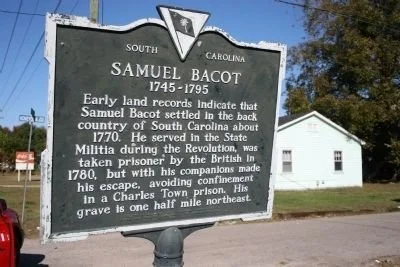
Samuel Bacot Historical Marker
Image: Samuel Bacot 1745-1795 Historical Marker, The Historical Marker Database.
In addition…
Thomas Wright Bacot, third of the name in annals of the Bacot family on this side of the Atlantic Ocean, helped to organize The Huguenot Society of South Carolina in the year 1885 as a charter member of the group. During his tenure of office as fifth president of the Society he compiled many records of early Huguenot history in the Carolina colony and deserves credit for much of the historical information published in early issues of the Transactions. At the same time, he devoted his energy to gathering into the Huguenot Society fold as many of the Bacot family as possibly could be reached, at home and afar. Transactions, Vol. 77

SUBMIT YOUR PATRIOT
If you would like to submit your patriot, please write your submission and email it to office@huguenotsociety.org